
Book Appointment Now
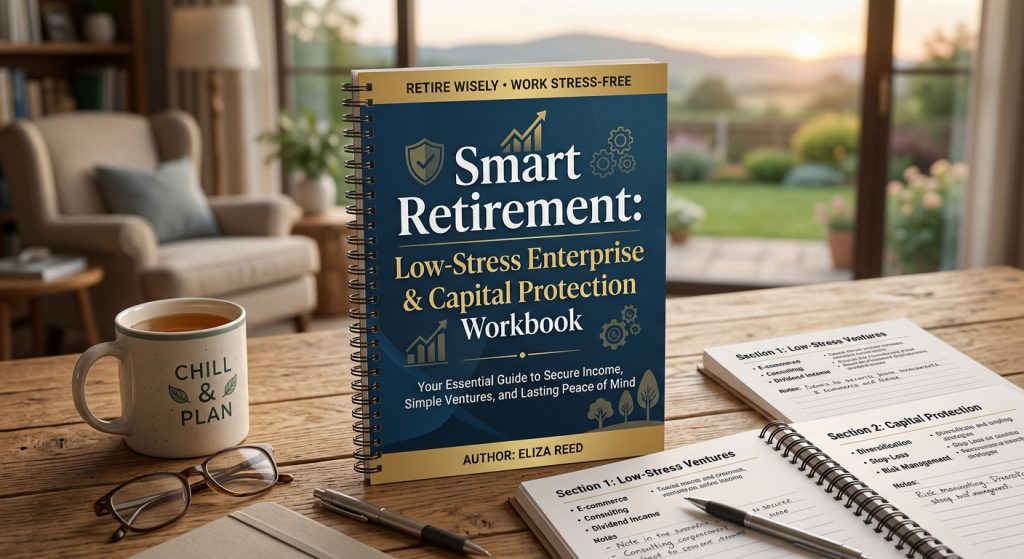
Smart Retirement: Low-Stress Enterprise & Capital Protection Workbook
Retirement represents a fundamental shift in a professional’s psychological landscape, income dynamics, and daily routine. For senior executives, civil servants, and corporate leaders, the transition from active workforce participation to retirement is often met with uncertainty. Broadly speaking, individuals in or near this phase fall into two distinct groups:
- Pre-Retirees: Professionals within 1 to 5 years of departure who feel unprepared for life without a structured corporate role.
- Recent Retirees: Individuals who have already received their severance or lump-sum settlement but remain hesitant to deploy capital due to fear of financial loss.
Leaving corporate life does not require stepping away from active economic participation. However, capital preservation must take precedence over high-risk expansion strategies.
The Smart Retirement: Low-Stress Enterprise & Capital Protection Workbook—published as an educational framework by distressperson.com—provides structured methodologies to transition corporate experience into stable, low-stress income ventures without risking accumulated retirement assets.
The Retirement Paradox: Corporate Identity Loss and Financial Vulnerability
[ Active Career ] ──> High Overhead & High Stress ──> Peak Income
                                                               │
                                                       (Transition Phase)
                                                               │
[ Smart Retirement ] ──> Low-Stress / Asset-Light ──> Capital Protection First
Transitioning out of active corporate service presents both psychological and financial challenges:
- Loss of Professional Identity: Decades of structured decision-making, executive authority, and daily routine vanish overnight. This shift can create a vacuum, often leading professionals to make hasty, ill-advised capital investments.
- Capital Vulnerability: Retirees are often targeted by high-yield investment schemes, predatory franchises, or capital-intensive ventures that demand operational involvement unsuitable for this stage of life.
- Macroeconomic Pressures: High inflation rates and currency fluctuations can erode fixed pension payouts, making supplemental, low-stress cash flows increasingly valuable.
The primary objective during retirement is not speculative wealth creation; it is capital defense paired with low-stress yield generation.
4 Low-Stress Micro-Enterprise Models (Under ₦500k / Sub-$1,000 Capital Ceiling)
Deploying large sums of retirement capital into unfamiliar commercial operations presents unnecessary financial risk. The workbook emphasizes asset-light models that require minimal operational infrastructure, zero inventory liability, and capped daily hours.
Below are four structural frameworks designed for practical deployment:
| Business Model Framework | Primary Operational Focus | Capital Allocation (₦500k Ceiling) | Estimated Monthly Yield Range | Operational Stress & Risk Mitigation Factors |
|---|---|---|---|---|
| POS & Agency Banking Hub | Essential financial services (withdrawals, transfers, utility bill processing) via localized channels. | • Terminal Unit: ₦25,000 • Operational Float: ₦420,000 • Kiosk/Umbrella Setup: ₦35,000 | ₦45,000 – ₦90,000 | Sit-down setup, zero inventory expiration risk, fast liquidity turnaround. |
| Specialized B2B Advisory | Monetizing executive knowledge, institutional compliance, and operational training for local SMEs. | • Refurbished Workstation: ₦220,000 • Branding & Collateral: ₦50,000 • Logistics Float: ₦80,000 • Capital Buffer: ₦150,000 | ₦50,000 – ₦200,000 | Client meetings by appointment only, 100% intellectual delivery, no physical stock. |
| Residential FMCG Distribution | Direct-to-consumer delivery of fast-moving household consumables from home frontage or estate gates. | • Fast-Moving FMCG Inventory: ₦350,000 • Display Racks & Security: ₦100,000 • Cash Flow Buffer: ₦50,000 | ₦40,000 – ₦80,000 | Zero commercial lease costs, operated within residential boundaries, high turnover. |
| Managed Commercial Laundry Hub | Acting as a customer intake and press-only center while outsourcing heavy washing to local partners. | • Commercial Steam Unit: ₦120,000 • Racks & Packaging: ₦30,000 • Local Marketing: ₦50,000 • Operational Float: ₦270,000 | ₦50,000 – ₦110,000 | No heavy manual labor; operations limited to intake, quality control, and garment pressing. |
The 15% Gratuity Defense Protocol
A core principle of post-career financial planning is protecting primary retirement liquidity.
Total Retirement Lump Sum / Gratuity (100%)
 │
 ├─── Maximum Allocation for New Micro-Venture: 15% (Capped at ₦500,000 / $1,000)
 │
 └─── Protected Fixed Reserve: 85%+ (Treasury Bills / Money Market / Sovereign Debt)
Capital Allocation Safeguards
- The 15% Allocation Ceiling: Never commit more than 15% of total gratuity payouts—and no more than ₦500,000—to an active enterprise.
- Account Segregation: Operating capital must be kept entirely separate from pension payout accounts to prevent cash flow dilution.
- Low-Risk Yield Reserves: The remaining 85%+ of capital should remain anchored in fixed-income sovereign securities, money market accounts, or capital-preserved institutional vehicles.
- The 30-Day Phased Test: Run initial operations at partial capacity for 30 days before committing full planned capital.
The 4-Hour Daily Operational Routine
Excessive operational demands can defeat the purpose of a structured retirement. Active commercial participation should be structured to prevent physical fatigue and burnout.
08:00 AM - 10:30 AM  │ [Phase 1] Morning Operations (Peak Activity & Initial Transactions)
10:30 AM - 11:30 AM  │ [Phase 2] Administrative Audit & Reconciliation Log Update
11:30 AM - 03:30 PM  │ [Phase 3] Mandatory Mid-Day Break (Personal Time & Delegation)
03:30 PM - 05:00 PM  │ [Phase 4] Evening Wrap-Up & Cash Settlement Protocol
- 08:00 AM – 10:30 AM (Peak Operations): Handle initial client inquiries, process daily transactions, and review setup needs.
- 10:30 AM – 11:30 AM (Administrative Audit): Log receipts, update daily registers, and track cash inventory.
- 11:30 AM – 03:30 PM (Mid-Day Rest): Pause operations or hand off monitoring to a trusted assistant.
- 03:30 PM – 05:00 PM (Closing & Reconciliation): Complete end-of-day balances, secure operational floats, and close daily transactions.
Fraud Prevention Framework for Retirees
Financial scams targeting retirees are increasingly sophisticated. Preserving capital requires adhering to strict operational security guidelines:
- Proof-of-Payment Verification: Never dispatch goods or release cash floats based on SMS messages or physical receipts. Confirm incoming transfers directly through official banking software or POS terminals.
- Unrealistic Return Schemes: Avoid partnerships, investment pools, or financial schemes promising fixed monthly returns above market rates without audited, physical assets.
- Identity Verification Protocols: Pension Fund Administrators (PFAs), regulatory agencies, and financial institutions will never call to request sensitive credentials, including One-Time Passwords (OTPs), PINs, or verification codes.
- Overnight Cash Controls: Minimize physical cash stored at home or in unsecured kiosks. Transfer operational funds to secure accounts at the end of each business day.
Implementation Roadmap: 30-Day Operational Execution Plan
Week 1: Selection & Site Verification
 └── Choose model, evaluate location, and align schedule with family.

Week 2: Account Segregation & Procurement
 └── Open separate bank account, fund initial setup, and secure core assets.

Week 3: Low-Capacity Trial Phase
 └── Launch operations at partial scale and begin daily log entries.

Week 4: Performance Evaluation
 └── Calculate net income, assess physical comfort, and adjust routines.
Days 1 – 7: Research & Selection Phase
- Select an enterprise model aligned with your physical comfort and local market demand.
- Verify your planned location (e.g., home frontage, estate gate, or commercial kiosk).
- Establish daily operational boundaries with family members.
Days 8 – 15: Corporate Infrastructure & Capital Deployment
- Open a dedicated commercial bank account exclusively for enterprise operations.
- Allocate initial operating capital within the approved 15% threshold.
- Procure core equipment, display inventory, or technology hardware.
Days 16 – 23: Pilot Launch & Recordkeeping
- Begin limited daily operations following the 4-hour schedule.
- Maintain daily entries in your accounting register.
Days 24 – 30: Evaluation & Operational Adjustments
- Review net operating yield against weekly time invested.
- Evaluate personal comfort and physical fatigue levels on a 1-to-5 scale.
- Fine-tune operational hours or delegate routine tasks if fatigue exceeds target thresholds.
Frequently Asked Questions (FAQ)
What if I have been retired for years and feel disconnected from current market trends?
Start with low-barrier, service-oriented models like B2B advisory or agency banking. These options rely on institutional experience and established networks rather than complex supply chains or emerging consumer trends.
How do I balance starting a business with preserving health and wellbeing?
Stick to the 4-hour operational schedule and keep active capital under the ₦500,000 ceiling. Avoid heavy physical labor, long transit times, or inventory models that require complex logistics.
Is agency banking safe for retirees given modern fraud risks?
Yes, provided you enforce strict operational checks: never rely on customer-provided payment screenshots, confirm every transaction directly via your terminal or official bank portal, and sweep daily cash balances into secure bank accounts before closing.
Should I partner with family members on a new venture?
If partnering with family, maintain formal boundaries: establish separate accounts, define clear roles, and retain final authorization on capital expenditures. Never pool retirement capital without clear, written agreements.
Resources & Educational Support
For additional templates, operational registers, and educational materials:
- Educational Portal: https://distressperson.com
- Support Contact: support@distressperson.com
- Community Resources: Access educational guides and resource materials via the distressperson.com platform.
Legal & Educational Disclaimer: This material is published by distressperson.com strictly for educational, informational, and awareness purposes. Financial projections, capital allocation limits, and business frameworks serve as general guides based on local market conditions and do not constitute professional financial, tax, or legal advice. Readers should perform independent due diligence and consult certified financial advisors or Pension Fund Administrators (PFAs) prior to committing retirement capital.