
Book Appointment Now
Waking Up at 2AM and Checking Your Phone? How Midnight Screen Time Affects Sleep, Stress and Your Eyes
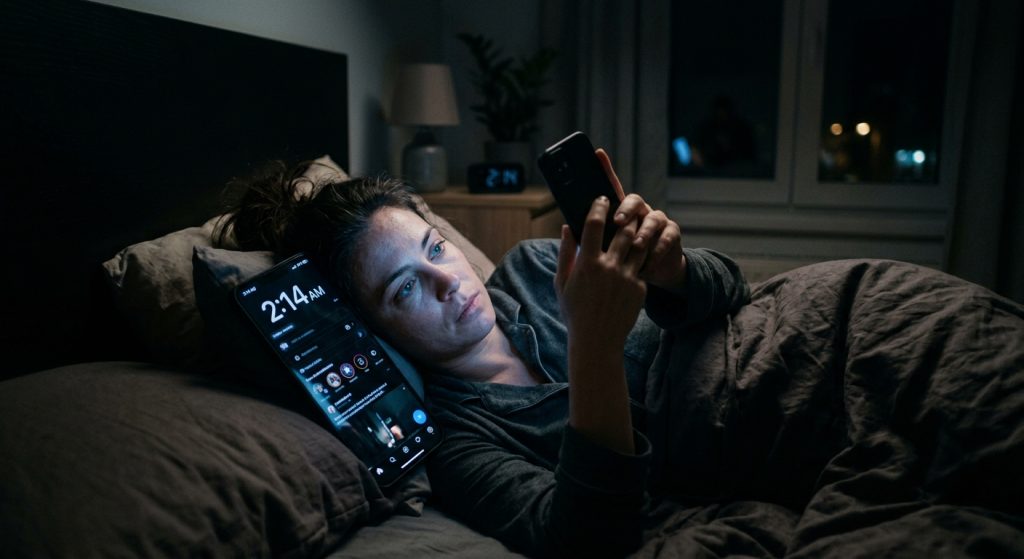
Waking up at 2 a.m. can happen to almost anyone. You open your eyes, reach for your phone, check the time—and then notice a WhatsApp message, Instagram notification, TikTok video, YouTube recommendation, email or news update.
You tell yourself, “I’ll only check for five minutes.”
Thirty minutes later, you are still scrolling.
For some people, this becomes a regular nighttime habit. They wake between 1 a.m. and 3 a.m., reach for their Smartphone and begin browsing, watching videos, replying to messages or checking social media instead of trying to return to sleep.
But what happens when this becomes a routine?
Does looking at your phone at 2 a.m. damage your eyes? Can midnight scrolling make anxiety or stress worse? Does blue light really affect sleep? And what should you do if you wake up in the middle of the night and cannot resist checking your phone?
This article looks at the evidence and separates genuine concerns from common myths.
Important: The concern is not that ordinary smartphone use will suddenly “burn” your eyes or make you blind. The more established concerns involve sleep disruption, prolonged screen exposure, eye strain and dryness, and the broader health effects associated with regularly getting insufficient or poor-quality sleep.»
What Does It Mean If You Keep Waking Up at 2AM?
Waking briefly during the night does not automatically mean that something is medically wrong.
Human sleep naturally consists of cycles, and people can experience brief awakenings. The problem can arise when waking becomes frequent, prolonged or associated with difficulty returning to sleep.
For example:
Healthy pattern:
Sleep → brief awakening → remain relaxed → return to sleep.
Potentially problematic pattern:
Sleep → wake at 2 a.m. → check phone → social media → videos → messages → news → continued stimulation → difficulty returning to sleep → reduced total sleep.
The phone can therefore turn a short awakening into a much longer period of wakefulness.
Your body’s internal circadian system uses light and darkness as important signals for determining when you should be awake and when you should feel sleepy. Bright artificial light in the evening or during the night can interfere with this process.
Why Does Checking Your Phone at 2AM Make It Harder to Go Back to Sleep?
There are several reasons.
1. The screen provides light at the wrong biological time
Your brain does not simply interpret light as something you can see.
Light reaching the eyes also provides information to the body’s circadian system.
The National Heart, Lung, and Blood Institute explains that artificial light can interfere with the normal light-dark cycle and that bright artificial light, including light from smartphones, can make it harder for the brain to release melatonin and prepare for sleep.
That does not mean every few seconds of phone use will completely destroy your sleep.
The concern is repeated exposure, particularly when it becomes prolonged and habitual.
2. Your brain becomes mentally engaged
The content you consume matters.
A calm message from a family member is very different from:
– an argument on social media
– breaking news
– financial information
– work emails
– frightening videos
– relationship problems
– political arguments
– exciting entertainment
– an endless stream of short-form videos
A person may wake up physically tired but become mentally stimulated after opening their phone.
Suddenly, the brain is no longer simply trying to return to sleep.
3. Social media has no natural stopping point
A book has a final page.
A television programme eventually ends.
Social media feeds can continue indefinitely.
One video becomes another.
One notification becomes another.
One search leads to another.
This is why “I’ll just check my phone for five minutes” can easily become an hour.
Does Midnight Phone Use Affect Sleep Quality?
It can.
The NHLBI recommends using the hour before bedtime for quiet time and avoiding bright artificial light, including light from screens, because it can signal to the brain that it is time to remain awake.
The NHLBI also recommends keeping the bedroom quiet, cool and dark and avoiding electronic devices that can disrupt the sleep-wake cycle.
The issue becomes particularly important when nighttime phone use reduces the total amount of sleep.
For most adults aged 18–60, the CDC recommends at least seven hours of sleep per night.
If somebody normally needs eight hours but spends an hour scrolling at 2 a.m., they may not simply be losing an hour of sleep.
They may also experience poorer sleep continuity and greater difficulty feeling refreshed the next day.
What Happens If You Regularly Sleep Less Than You Need?
Occasional short sleep is different from chronic sleep deficiency.
But consistently inadequate sleep is associated with a range of health concerns.
The NHLBI notes that insufficient quality sleep over time can increase the risk of conditions including heart disease, obesity, high blood pressure, diabetes and stroke.
The CDC similarly emphasizes that adequate sleep is important for physical health, emotional well-being and normal daytime functioning.
This does not mean that checking your phone once at 2 a.m. causes heart disease or diabetes.
The concern is the long-term pattern of inadequate or disrupted sleep.
That distinction is important.
Can Waking Up at Night and Checking Your Phone Increase Stress?
It can contribute to a cycle in some people.
Imagine this:
Stress → poor sleep → wake at 2 a.m. → check phone → encounter stressful information → become more alert → struggle to sleep → feel exhausted the next day → experience more stress.
The phone may therefore become part of the cycle rather than the original cause of the nighttime awakening.
For example, someone who wakes because they are already worried about money, work, relationships or an upcoming event may use their phone to distract themselves.
Unfortunately, checking emails, social media or news can sometimes introduce even more information for the brain to process.
Does Looking at Your Phone at Night Damage Your Eyes?
This is one of the biggest misconceptions surrounding nighttime smartphone use.
Ordinary smartphone screen exposure has not been established as a cause of blindness or permanent eye damage simply because it occurs at night.
The American Academy of Ophthalmology’s guidance, summarized through its EyeWiki resource, states that there is no scientific evidence that ordinary light coming from computer screens is damaging to the eyes and does not recommend special eyewear simply for computer use.
However, that does not mean prolonged screen use has no effect on the eyes.
There is a well-documented issue called digital eye strain.
What Is Digital Eye Strain?
Digital eye strain refers to a collection of symptoms that can occur during or after prolonged digital-device use.
Symptoms can include:
– dry eyes
– burning or irritation
– watery eyes
– blurred vision
– tired eyes
– difficulty focusing
– headaches
– eye discomfort
Research reviews have associated prolonged digital-screen use with dry-eye symptoms and changes in blinking behavior.
One important reason is that people often blink differently while concentrating on a digital screen.
Reduced or incomplete blinking can allow the tear film covering the eye to become less stable, contributing to dryness and discomfort.
So the problem isn’t necessarily:
“The phone light is burning your eyes.”
It is more accurately:
“You’re staring at a small, bright screen for a prolonged period while blinking less and maintaining close focus.”
Why Does Your Phone Make Your Eyes Feel Dry at Night?
Several factors can combine.
Prolonged close viewing
A smartphone is usually held much closer to the face than a television.
That means the eyes maintain prolonged near focus.
Reduced blinking
Concentration can reduce blinking, which can contribute to tear-film instability and dry-eye symptoms.
Dry bedroom environment
Air conditioning, fans and low humidity can increase ocular discomfort for some people.
Bright screen in a dark room
A very bright screen surrounded by a completely dark room can feel uncomfortable and increase glare or visual discomfort.
Long uninterrupted sessions
The longer you continue scrolling without looking away, the more likely you are to experience fatigue and discomfort.
Is Blue Light From Your Phone Dangerous?
This question requires some nuance.
Blue light is part of the visible light spectrum. Smartphones and other LED-based displays emit blue wavelengths.
The more established concern regarding nighttime exposure is circadian timing and sleep, rather than the idea that normal phone use is literally burning or destroying the retina.
The NHLBI explains that artificial light at night can interfere with the body’s circadian system and that smartphones and other bright electronic devices can provide wakefulness signals at a time when the body is preparing for sleep.
Blue-light filters or night modes may make nighttime screens more comfortable and reduce some blue-light exposure.
But Night Mode is not a permission slip to spend three hours on TikTok at 2 a.m.
The duration and timing of the activity still matter.
What About Using Your Phone in Complete Darkness?
If you wake at 2 a.m., avoid turning your bedroom into a mini cinema with a bright phone screen.
If you absolutely need to check something:
– reduce the brightness
– activate Night Light/Night Shift
– increase text size
– avoid holding the phone extremely close
– avoid prolonged scrolling
– return the phone to its normal location after checking what you need
Better still, avoid opening social media entirely.
A dark bedroom is generally more supportive of sleep than a bright, continuously illuminated environment.
What Should You Do When You Wake Up at 2AM?
Try this simple approach.
Step 1: Don’t immediately touch your phone
Give yourself a few minutes.
You may discover that you were only briefly awake.
Step 2: Don’t check social media
If you genuinely need to know the time, use a dim clock rather than opening a social media app.
Step 3: Keep your environment calm
Keep the room quiet and dark.
Step 4: Try slow breathing
Relax your body and avoid becoming frustrated because you aren’t asleep immediately.
Step 5: If you cannot fall back asleep
Rather than remaining in bed becoming increasingly frustrated, consider a quiet, relaxing activity in low light until you become sleepy again.
NHLBI sleep guidance includes getting out of bed for a relaxing activity if you cannot sleep and returning when you feel sleepy.
Step 6: Make your phone harder to reach
This is surprisingly effective.
Don’t place your smartphone directly under your pillow or beside your hand.
Put it across the room, on a table or somewhere that requires you to physically get up to retrieve it.
Seven Ways to Break the 2AM Phone-Scrolling Habit
1. Turn off unnecessary notifications
Not every notification deserves to wake you.
2. Put your phone away before bedtime
The goal is to reduce the temptation before it begins.
3. Use Do Not Disturb
Allow genuine emergencies or important contacts through while silencing unnecessary notifications.
4. Use Night Mode
This can reduce harshness and blue-light exposure, although it doesn’t replace good sleep habits.
5. Don’t sleep with your phone in your hand
Create physical distance between yourself and the device.
6. Give yourself a screen-free wind-down period
The NHLBI recommends using the period before bed for quieter activities and reducing bright artificial light.
7. Get natural light during the day
Daytime light is an important signal for the circadian system.
NHLBI guidance notes that spending time outside and getting natural daylight can support healthy sleep-wake rhythms.
When Should You Talk to a Healthcare Professional?
Occasional nighttime waking is common.
However, it is worth discussing persistent sleep problems with a healthcare professional if you regularly:
– struggle to fall asleep again
– wake repeatedly throughout the night
– feel excessively sleepy during the day
– wake feeling unrefreshed despite enough time in bed
– experience persistent insomnia
– snore heavily or have episodes of gasping/choking during sleep
– experience significant anxiety or low mood associated with sleep problems
You should also seek professional eye care if you experience persistent blurred vision, significant eye pain, persistent redness, flashes of light, new floaters, sudden vision changes or other concerning visual symptoms.
Do not assume every eye symptom is caused by your phone.
Frequently Asked Questions
Is it bad to check your phone when you wake up at 2AM?
It can be counterproductive if checking your phone turns a brief awakening into prolonged wakefulness. Screen light can also provide wakefulness signals to the circadian system.
Does looking at your phone at night damage your eyes?
Ordinary screen light has not been established as causing permanent eye damage or blindness. However, prolonged digital-device use can be associated with eye strain, dryness, irritation and blurred vision.
Can using your phone at night cause dry eyes?
Prolonged digital-screen use can contribute to dry-eye symptoms, partly because screen activities can alter blinking patterns.
Does blue light cause blindness?
There is no good evidence that ordinary exposure to light from smartphone screens causes blindness. The better-established nighttime concern is disruption of the sleep-wake system rather than the idea that smartphone blue light simply destroys the eyes.
Does Night Mode protect your eyes?
Night Mode can reduce the amount of blue-spectrum light emitted by the screen and may make nighttime viewing more comfortable. However, it does not eliminate digital eye strain or solve the problem of staying awake for hours using your phone.
How many hours of sleep should an adult get?
The CDC recommends at least seven hours of sleep per night for adults aged 18–60, with different recommendations for older age groups.
Why do I keep waking up at 2AM every night?
There can be many possible reasons, including stress, irregular sleep schedules, environmental factors, caffeine, alcohol, medications, medical conditions and sleep disorders. Waking at 2AM is not automatically evidence of a specific illness.
Should I use my phone if I can’t sleep?
If you need to use it briefly for something important, keep brightness low and avoid stimulating content. If you cannot sleep, a quiet, relaxing activity away from stimulating screens may be more helpful.
Is it better to sleep with your phone outside the bedroom?
For people who repeatedly wake and start scrolling, physically moving the phone away from the bed can be a practical behavioral strategy. It reduces the temptation to immediately begin browsing.
Can lack of sleep affect mental health?
Poor sleep and mental health are closely connected. Insufficient sleep can affect daytime functioning and emotional well-being, while stress and mental-health difficulties can also interfere with sleep. Persistent problems should be discussed with an appropriate healthcare professional.
Final Thoughts
Waking up briefly during the night is not necessarily a problem.
The bigger concern is what happens after you wake up.
If you reach for your phone and spend the next hour scrolling through social media, watching videos, reading news or answering messages, you may be turning a temporary awakening into a much longer period of wakefulness.
The evidence does not support the frightening claim that ordinary smartphone screens will simply destroy your eyes.
However, prolonged digital-device use can contribute to digital eye strain and dry-eye symptoms, while nighttime artificial light and stimulating screen activity can interfere with the body’s sleep-wake system.
And if nighttime phone use repeatedly cuts your sleep below what your body needs, the sleep loss itself deserves attention.
So the next time you wake at 2 a.m., consider doing something radical:
Don’t check your phone.
Put it down.
Close your eyes.
Let your brain remember that 2 a.m. is still nighttime.
Disclaimer
This article is provided for educational and informational purposes only and is not intended to diagnose, treat, cure or prevent any medical condition. It should not be considered medical, psychological, ophthalmological or professional healthcare advice. Individual health circumstances differ, and anyone experiencing persistent sleep difficulties, significant daytime sleepiness, persistent eye symptoms, sudden vision changes, severe anxiety, depression or other concerning symptoms should consult an appropriately qualified healthcare professional.
The information provided on DistressPerson.com is intended for general educational purposes and may include general wellness, health-awareness, business-to-business (B2B), professional and informational content. It is not a substitute for consultation with a qualified healthcare provider, licensed professional or other appropriate specialist. DistressPerson.com and its contributors do not assume responsibility for decisions made solely on the basis of information contained in this article.