
Book Appointment Now
Is Your Child Waking Up at Night to Use Their Phone? How Midnight Screen Time Affects Sleep, Eyes and Mental Well-Being
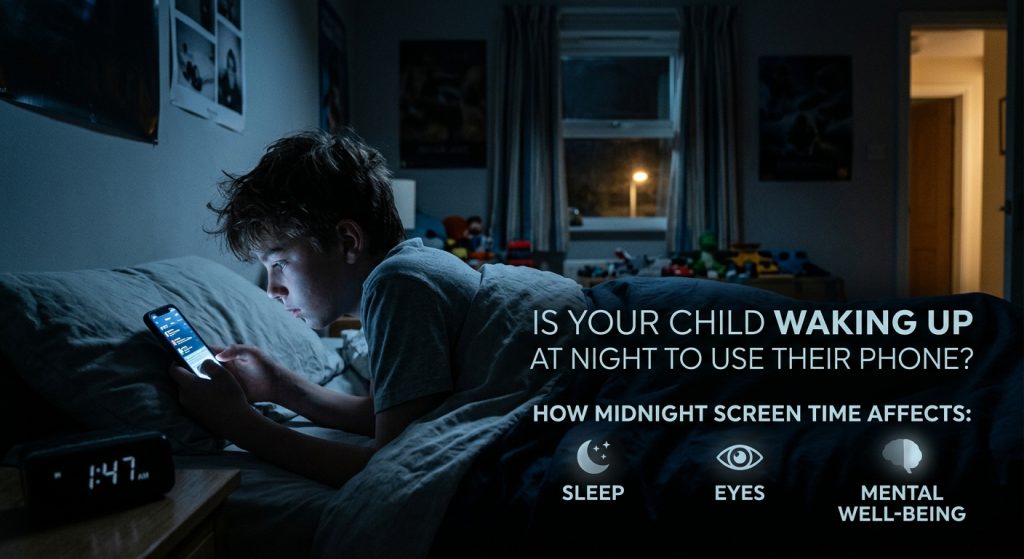
A child wakes up at 2 a.m.
Instead of turning over and going back to sleep, they quietly reach for their smartphone.
A few minutes of TikTok becomes YouTube.
YouTube becomes WhatsApp.
WhatsApp becomes Instagram, Snapchat, gaming or messaging friends.
Before the child realizes it, an hour—or sometimes several hours—has passed.
The parent may never know.
The child eventually puts the phone down, falls asleep and wakes up tired for school.
For many parents in the United States, Canada and the United Kingdom, children’s access to smartphones, tablets and other connected devices has created a new nighttime challenge: what happens when the screen follows a child into the bedroom?
This question matters because children and teenagers need adequate sleep for healthy development, learning, mood and daily functioning. Research from the American Academy of Pediatrics and other sources indicates that digital media use around bedtime can interfere with children’s sleep through several mechanisms, including light exposure, stimulating content and the presence of devices in bedrooms.
There are also legitimate questions about children’s eyes. Recent systematic reviews and meta-analyses have found associations between greater digital-screen exposure and myopia in children and adolescents, although researchers continue to study exactly how much of the relationship is caused by screens themselves versus related behaviors such as prolonged near work and reduced outdoor time.
So should parents ban smartphones?
Not necessarily.
The more useful question is:
How can parents help children use technology without allowing nighttime screen habits to interfere with sleep, health, learning and family life?
Why Are Children Checking Their Phones at Night?
Children and teenagers may use their phones at night for many different reasons.
Some are simply curious.
Others are communicating with friends.
Some are afraid of missing out on conversations.
Others use social media because they are bored or unable to sleep.
Gaming can be particularly engaging because games are designed around goals, rewards, challenges and continuous progression.
Short-form video platforms create another problem: there may be no obvious point at which the experience ends.
One video automatically leads to another.
That makes it easy for a child to lose track of time.
For teenagers, nighttime phone use may also be connected with social pressure.
A child may worry:
“What if my friends are talking without me?”
“What if someone messages me?”
“What if I miss something?”
This can make putting the phone away considerably harder than simply telling a child, “Go to sleep.”
Why Is Midnight Phone Use Different for Children?
Children and teenagers are still developing physically, emotionally and cognitively.
Sleep is not simply a period when the body shuts down.
It is part of the biological process supporting learning, memory, emotional regulation, physical development and overall health.
The American Academy of Pediatrics’ recent technical report on digital ecosystems notes strong evidence that digital media can disrupt children’s and adolescents’ sleep duration, timing and quality. It identifies several possible mechanisms, including screen light, stimulating content and mobile devices remaining in bedrooms.
Therefore, a smartphone beside a child’s pillow can create several problems simultaneously:
The child can see the screen.
The child can hear notifications.
The child can receive messages.
The child can become emotionally stimulated.
The child can continue using the device long after bedtime.
And perhaps most importantly:
The device is always available.
Does Phone Screen Light Affect Children’s Sleep?
It can.
Light is one of the signals that helps regulate the body’s circadian system—the internal timing system that helps determine when we feel awake and when we feel sleepy.
Screen exposure at night can provide light during a period when the body should be moving toward sleep.
The American Academy of Pediatrics explains that blue-spectrum light from screens can suppress melatonin and contribute to greater alertness and changes in sleep timing.
But light is not the only issue.
The content itself matters
Imagine two situations.
Child A: reads a calm book before bed.
Child B: watches an exciting gaming livestream, receives messages from friends and watches emotionally stimulating videos.
Even though both involve a screen, the second situation may be much more activating.
That is why parents should think about what children are doing on their devices, not only how bright the screen is.
What Happens When a Child Regularly Loses Sleep?
One late night is unlikely to cause major harm.
The bigger concern is a repeated pattern.
A child who regularly stays awake until midnight or 1 a.m. because of their phone may arrive at school having had insufficient sleep.
That can affect:
– attention
– concentration
– mood
– learning
– reaction time
– daytime alertness
– emotional regulation
– school participation
The American Academy of Pediatrics has previously highlighted associations between bedtime media use, sleep disruption and school performance.
Parents should therefore avoid thinking of nighttime phone use as simply a “technology problem.”
It can become a sleep problem.
And sleep can influence the child’s entire next day.
Can Phones Damage Children’s Eyes?
This question requires careful explanation.
Parents sometimes hear claims such as:
“The phone will damage your child’s eyes.”
That statement is too simplistic.
Ordinary smartphone use has not been established as something that automatically causes blindness or permanently burns a child’s eyes.
However, children can experience problems associated with prolonged digital viewing, including digital eye strain, dry eyes and visual discomfort.
More importantly, research has increasingly investigated the relationship between digital screen exposure and myopia, commonly called short-sightedness.
What Is Myopia?
Myopia is a refractive condition in which distant objects appear blurry.
A child with myopia may struggle to read information on a classroom board while being able to see a book or phone relatively clearly at close range.
This matters because childhood myopia can progress as children grow.
A 2025 systematic review and dose-response meta-analysis involving 45 studies and 335,524 participants, with a mean age of about 9 years, found that increasing daily digital-screen exposure was associated with higher odds of myopia. The researchers emphasized an association rather than proving that screen exposure alone causes myopia.
A separate 2026 systematic review focused on European children and adolescents similarly found associations involving screen-related behavior, prolonged near work and reduced outdoor exposure, but noted that the evidence was heterogeneous and often observational, meaning causation cannot be confidently established from the available evidence.
That distinction is extremely important.
Parents should not panic because their child owns a smartphone.
Instead, the goal should be balanced screen use, regular visual breaks, appropriate viewing distance and sufficient outdoor activity.
Why Outdoor Time Matters
One of the interesting findings in research on childhood myopia is the role of outdoor activity.
Children aren’t simply replacing screen time with nothing.
When a child spends hours looking at a screen, they may also be spending less time outdoors.
Outdoor activity provides exposure to natural daylight and gives children opportunities to look at objects at varying distances rather than maintaining prolonged close focus.
Recent research continues to identify outdoor exposure as an important factor in discussions about childhood myopia.
This means parents should not think only:
“How many hours is my child on the phone?”
They should also ask:
“How much time does my child spend outdoors?”
Does Looking at a Phone in the Dark Damage Children’s Eyes?
There is no good reason to tell parents that a phone used in a dark room will literally burn or permanently damage a child’s eyes.
But there are several reasons to discourage the habit.
A bright screen in a dark bedroom can be visually uncomfortable.
Prolonged close viewing can contribute to eye fatigue.
Children may blink less while concentrating on screens.
And most importantly, nighttime phone use can keep the child awake.
So the bigger concern is not:
“The screen is going to destroy your child’s eyes tonight.”
It is:
“Your child may be spending prolonged periods staring at a close screen when they should be sleeping.”
Why Nighttime Gaming Can Be Particularly Difficult
Gaming deserves special attention.
A child may say:
“I’m not using social media. I’m just playing a game.”
But gaming can be highly stimulating.
There may be:
– competition
– rewards
– levels
– achievements
– friends communicating through headsets
– live events
– time-limited challenges
– emotional excitement
A child who is physically tired may still feel mentally activated.
This can make the transition from gaming to sleep more difficult.
What About TikTok, YouTube Shorts and Instagram Reels?
Short-form video deserves particular attention because of its continuous design.
There is no natural endpoint.
The child doesn’t reach the end of a movie and turn the television off.
Instead:
Swipe → video → swipe → video → swipe → video.
The next piece of content arrives immediately.
That can make time difficult to judge.
Parents may therefore find that setting a stopping point is more effective than simply telling a child to “use the phone less.”
The Hidden Problem: Notifications
Even if a child isn’t actively using their phone, notifications can interrupt sleep.
A message arrives.
The phone vibrates.
The screen lights up.
The child becomes curious.
They check.
Then they start browsing.
This is why nighttime device management should include notifications, not merely screen brightness.
Should Children Sleep With Their Phones Beside Their Beds?
For children who have difficulty resisting nighttime phone use, keeping the device outside the bedroom can be a practical strategy.
This doesn’t mean that every child who sleeps with a phone will develop a health problem.
Rather, removing easy access eliminates one major temptation.
A simple family rule can be:
“Phones charge outside the bedroom overnight.”
The rule can apply to parents too.
Children are more likely to accept healthy technology boundaries when adults follow them themselves.
How Parents Can Stop Midnight Phone Scrolling
1. Create a family charging station
Choose one location outside bedrooms where phones and tablets are charged overnight.
This removes the device from the child’s immediate reach.
2. Establish a consistent device bedtime
Instead of negotiating every night, establish a predictable time when entertainment screens are put away.
The exact time should account for the child’s age, school schedule and required sleep.
3. Use parental controls
Modern smartphones, tablets and operating systems provide tools that can help parents manage:
– bedtime access
– app limits
– content restrictions
– notifications
– purchasing
– communication
– screen-time reports
Parents should explain these controls rather than secretly relying on them whenever possible.
4. Turn off unnecessary notifications
There is little reason for a child’s phone to vibrate throughout the night because of non-urgent notifications.
5. Don’t use the phone as the child’s only sleep solution
If a child says:
“I can’t sleep without YouTube.”
That is worth paying attention to.
Help the child develop other calming routines.
These might include:
– reading
– quiet music
– relaxation exercises
– talking with a parent
– journaling for older children
– a consistent bedtime routine
6. Make bedrooms sleep-friendly
Keep the bedroom comfortable, quiet and conducive to sleep.
A phone should not become the main source of entertainment after the lights go out.
7. Encourage outdoor activity
Outdoor play, walking, sports and other age-appropriate physical activities can provide valuable daylight exposure and reduce sedentary screen time.
8. Teach children why the rules exist
“Because I said so” may work temporarily.
Understanding works better in the long term.
Tell children:
“We’re not taking your phone because phones are bad. We’re protecting your sleep.”
That changes the conversation.
What If Your Child Wakes Up at 2AM?
This is where parents should pay particular attention.
If a child wakes occasionally, there may be no reason to panic.
But if the pattern is:
Wake → phone → social media/gaming/videos → stay awake → sleep late → tired at school
then the phone has become part of the sleep problem.
Consider removing the phone from the bedroom at night.
If the child continues waking frequently despite removing the device, investigate other possible causes.
These can include:
– anxiety
– nightmares
– stress
– irregular sleep schedules
– caffeine
– uncomfortable bedroom conditions
– medical conditions
– sleep disorders
A healthcare professional can help determine whether there is an underlying problem.
Signs Your Child May Be Getting Too Much Nighttime Screen Exposure
Watch for patterns such as:
– hiding the phone under the pillow
– becoming unusually upset when asked to put the phone away
– repeatedly staying awake after bedtime
– using the phone secretly overnight
– struggling to wake for school
– excessive daytime sleepiness
– declining concentration
– headaches or eye discomfort after prolonged screen use
– complaining about blurred distance vision
– spending substantially less time outdoors
– repeatedly breaking agreed screen boundaries
– using screens despite being clearly exhausted
One sign alone doesn’t establish a problem.
The pattern is what matters.
When Should Parents Arrange an Eye Examination?
Parents should consider professional eye evaluation if a child:
– squints frequently
– sits very close to the television
– holds books or screens unusually close
– complains about blurred distance vision
– struggles to see the classroom board
– frequently reports headaches associated with visual tasks
– complains of persistent eye discomfort
– has difficulty reading distant signs
– appears to have one eye turning or drifting
Don’t automatically blame the phone.
Children can develop vision problems for many reasons, and an eye-care professional can properly assess them.
When Should a Parent Talk to a Doctor About Sleep?
Speak with a healthcare professional if a child consistently:
– has difficulty falling asleep
– wakes repeatedly
– is excessively sleepy during the day
– snores loudly or regularly
– gasps or appears to stop breathing during sleep
– has persistent nightmares or sleep disturbances
– experiences significant anxiety affecting sleep
– has major daytime behavioral or concentration changes
Nighttime phone use may be contributing to the problem, but it isn’t necessarily the only explanation.
A Simple “No Phone After Bedtime” Plan
Parents who want a practical starting point can try this:
One hour before bedtime:
Begin winding down.
30–60 minutes before bedtime:
Entertainment screens are switched off.
At bedtime:
Phone and tablet go to the family charging location.
During the night:
No entertainment devices in the bedroom.
Morning:
The child retrieves the device after waking.
During the day:
Encourage outdoor activity, movement and non-screen activities.
The exact schedule can be adjusted to the child’s age and family routine.
The goal isn’t perfection.
The goal is consistency.
Frequently Asked Questions
Does phone use at night damage children’s eyes?
Prolonged screen use can cause eye strain and discomfort, but it is not accurate to say that ordinary smartphone use automatically causes permanent eye damage or blindness. Research has also found associations between greater digital-screen exposure and myopia in children, although causation and the contribution of related behaviors such as near work and outdoor exposure remain under investigation.
Can phones cause myopia in children?
Current research supports an association between greater digital-screen exposure and myopia, but saying that phones alone “cause” myopia goes beyond the evidence. Genetics, near work, outdoor exposure and other environmental factors also matter.
Is blue light from phones bad for children’s sleep?
Nighttime screen light can affect the circadian system and melatonin, while stimulating content can also increase alertness. The American Academy of Pediatrics identifies both light exposure and stimulating digital content as mechanisms through which screens can interfere with children’s sleep.
Should children use phones before bed?
Parents may find it helpful to establish a screen-free wind-down period before bedtime, particularly if the child has difficulty falling asleep or repeatedly stays awake using the device.
Should my child sleep with their phone?
If the child regularly uses the phone at night, keeping it outside the bedroom can be a practical way to reduce temptation and interruptions. A family charging station can make this easier.
How many hours of screen time should a child have?
There isn’t one universal number that works for every child and every type of screen use. Age, developmental stage, schoolwork, physical activity, sleep, family circumstances and the purpose of screen use all matter. Parents should focus not only on a numerical limit but also on whether screen use is interfering with sleep, school, relationships, physical activity and other important activities.
Is watching YouTube in bed bad for children?
It can become problematic if watching YouTube delays bedtime, reduces total sleep or becomes difficult for the child to stop. Content that is exciting, frightening or emotionally stimulating may also make it harder to settle down.
Can nighttime phone use make children tired at school?
Yes, if phone use delays sleep or causes insufficient sleep. The American Academy of Pediatrics has linked bedtime media use with sleep disruption and potential effects on school functioning.
Is gaming before bed bad for children’s sleep?
Gaming can be particularly stimulating, especially when it involves competition, rewards or social interaction. For some children, playing immediately before bedtime can make it harder to transition into sleep.
Should parents take away their child’s phone at night?
For a child who repeatedly uses the phone after bedtime, temporarily removing nighttime access can be a reasonable household strategy. The goal should be establishing healthy sleep habits rather than punishing the child.
Does Night Mode make phone use at night safe?
Night Mode can reduce blue-spectrum light and may make screens more comfortable, but it does not make prolonged nighttime scrolling harmless. The child can still be exposed to stimulating content and remain awake for longer than intended.
Does screen time affect children’s mental health?
The relationship is complex. Digital media can provide social connection, entertainment, education and support, but excessive or poorly timed use can interfere with sleep and other healthy activities. Parents should pay attention to the child’s overall pattern rather than assuming every use of technology is harmful.
What should I do if my child secretly uses their phone at night?
Start with a calm conversation rather than immediately treating the behavior as defiance. Ask why they are using it—social communication, entertainment, anxiety, boredom or difficulty sleeping may all require different solutions. Then establish clear nighttime boundaries and consider charging the phone outside the bedroom.
Final Thoughts for Parents
Technology is not the enemy.
Smartphones, tablets, computers, games and online platforms are now part of children’s education, communication and entertainment.
The goal isn’t necessarily to remove technology from a child’s life.
The goal is to make sure technology doesn’t take over the hours that a child’s body and brain need for sleep.
If your child wakes at 2 a.m. and immediately reaches for a phone, don’t focus only on the device.
Look at the bigger picture.
Is your child getting enough sleep?
Is the phone interfering with bedtime?
Is your child spending enough time outdoors?
Are they experiencing eye discomfort or difficulty seeing at a distance?
Is social media creating anxiety or pressure?
Is gaming keeping them mentally stimulated late into the night?
Those questions are more useful than simply asking how many hours the child spent on a screen.
And remember:
A phone in a child’s bedroom doesn’t have to become a nightly battle.
With clear boundaries, consistent routines, parental involvement and a healthy balance between technology, sleep, physical activity and real-world relationships, children can learn to use digital technology without allowing it to control their nights.
Disclaimer
This article is provided by DistressPerson.com for educational and informational purposes only. It is not intended to diagnose, treat, cure or prevent any medical condition and should not be considered medical, psychological, ophthalmological, pediatric or other professional healthcare advice.
Children are individuals, and recommendations may differ according to age, development, health history, sleep needs, family circumstances and other factors. Parents and caregivers should consult a qualified pediatrician, family doctor, optometrist, ophthalmologist, psychologist or other appropriately licensed healthcare professional when a child has persistent sleep difficulties, significant daytime sleepiness, behavioral concerns, persistent eye symptoms, vision changes, breathing problems during sleep or other concerning symptoms.
The information on DistressPerson.com may include general health education, wellness information, parenting information, business-to-business (B2B) information and other educational content. It does not create a doctor-patient, therapist-client or other professional relationship between the reader and DistressPerson.com or its contributors. Any products, services, organizations or resources mentioned should be independently evaluated and are not necessarily endorsements. DistressPerson.com and its contributors do not assume responsibility for decisions made solely on the basis of information contained in this article.
Information and scientific understanding can change as new research becomes available. Always seek appropriate professional advice for a child’s individual circumstances.